SPORT IN JAMAICA

(First published March 2018)

If you ever doubt the global blanket of sports television, just know there’s something called ESPN Caribbean.  There’s and ESPN Asia, Australia, Brazil, and ESPN-UK too.  To my research there is no ESPN-Siberia yet. The ESPN Caribbean network airs in 32 countries, including one I visited recently.  ESPN Caribbean SportsCenter in Jamaica features sports like America’s Cup yacht racing, grand slam tennis, a little golf, something called Netball (the “Jamaican Sunshine Girls” team is currently ranked third in the world), and a whole lot of soccer and cricket.  There is most certainly MLB, NBA and NFL action, but not before you wade through scores and highlights of the Caribbean Premier League, the Caribbean Super 50, the Karbonn Smart League, the English Premier League, German Bundesliga, Spanish La Liga, Italian Serie A Soccer, and the uber-important International Cricket Council with its wickets, nurdles, and wicked googlies.  If I could name a single famous cricketer, Jamaican or otherwise, I would do it here.  I can’t, but I do know that Patrick Ewing was born in Kingston, Jamaica and excelled at that game along with soccer.  Jamaican icon Bob Marley was supposed to be excellent on a football pitch.

Usain Bolt currently dominates the Jamaican sports scene, as much as a single athlete can; the fastest human in the history of the world will tend to capture the attention of the nation in which he has born. 

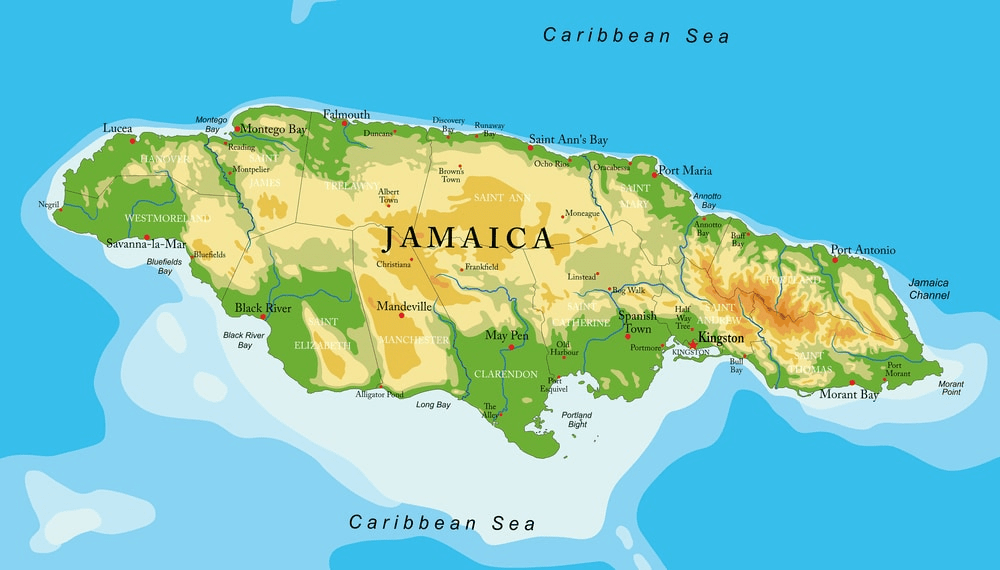
He is relatively absent in the media, as Jamaicans seem to love their sports and sporting action more than they worship their sportsmen and women.  Bolt adorns a few roadside billboards, shilling for cell services and energy drinks, but other than that he’s not as ubiquitous as you’d think.  Opposite of the U.S. where we tend to define the performance by the performer, and an athlete like LeBron James can shake the rust off the belt of a once-proud city like Cleveland with one moving van full of sneakers, tank tops, and elbow pads (c’mon Buckeyes, he didn’t cure cancer, he plays basketball).  On a short bus trip from Montego Bay (the inspiration of The Beach Boys, Bobby Bloom and Jimmy Buffet) to Falmouth in Trelawny Parish (where James Bond jumped a speed boat onto a cop car) our tour group passed Bolt’s high school, what are the odds? Ben Johnson, incidentally is infamously from Falmouth also, must be something FAST in the water there.  The fact of that coincidence was startling until you realize that there are only 2.7 million-some people on the island spread out over 4,244 square miles, a good two-thirds of it coastal and accessed from the main highway; not exactly like landing in Los Angeles and randomly driving by the White House.

The Jamaican Bobsled team famously competed in the 1988 Calgary Olympics Winter Games.  Disney made a movie about them called Cool Runnings, and that name is plastered on everything from convenience stores to jet-ski rentals shops. 

Side note, renting jet-skis is against the law in Jamaica because tourists kept smashing into each other on them.  As you’d imagine on a Caribbean island (where the ocean water temperature in August is a squishy 97 degrees by the way), water sports are plenty, the moratorium on wave-runners notwithstanding; scuba diving, windsurfing, sailing, waterskiing, snorkeling, parasailing, and deep sea fishing.

The poverty in a Caribbean country like Jamaica registers when you internalize the fact that it can’t snow there.  No population could survive a frigid climate in homes with so few amenities, like running water, a workable furnace and, often, walls and floors.  I found myself and my family being escorted up the North Coastal Highway in a local taxi, from Negril to Mon-Bay.  We were escorted by friends of a friend, real Rasta’s, dreads and all.  The view was postcard tropical, blue-green ocean waves crashing on beach-heads and cliff sides.  We stopped at a roadside shack, one of many, for something cold to cut into into the tropical heat.  Our guides knew the place.  They talk with the proprietor.  Jamaicans speak English, until they don’t want you to understand them, then they speak something that isn’t English.  Soon were sipping water from a raw coconut, and a mango concoction from a plastic cup.

I wander out of the broken-down bar, all particle board and corrugated tin.  There along the roadway two kids are kicking a half flat soccer ball in a dirt driveway. Yeah, they like their sports in Jamaica.  I lace up my shoes and join in.

NOT THAT KIND OF CASINO; BEMUS POINT, NY

Crank up your search engines.

Now Google Count Basie, Lena Horne, Tommy Dorsey Orchestra, Buddy Rich, Old Blue Eyes (Frank Sinatra), Sammy Kaye, Ozzy Nelson (of Ozzie and Harriet fame), Duke Ellington, Benny Goodman.

You’ve just surveyed the most famous entertainers from the 1930’ and 40’s, world renown performers of music and theater, classical big bands, jazz musicians, stand-up comedians, multi-talented entertainers. People who could book and fill any arena in the country from coast to coast, Carnegie and Radio City Music Halls, The Cotton Club, The Biltmore.

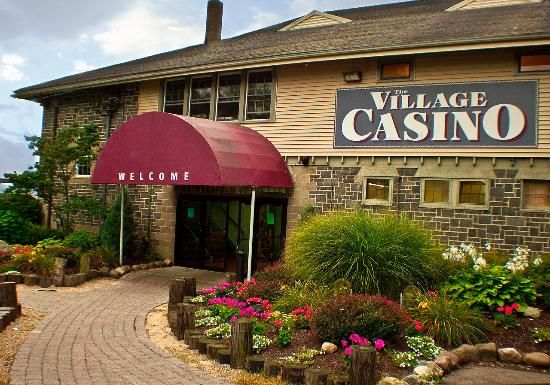
One of the prize bookings of these famous artists was The Village Casino, right here in Bemus Point, New York. Every person from the above list, among others, performed in that building.

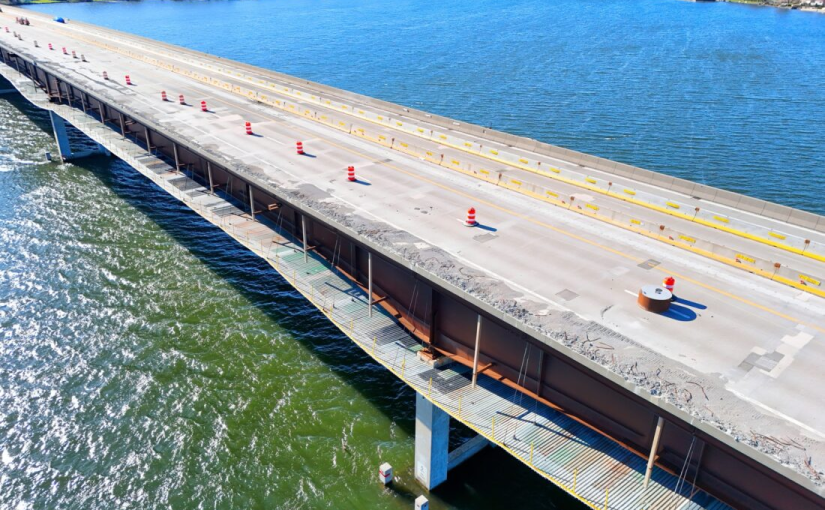
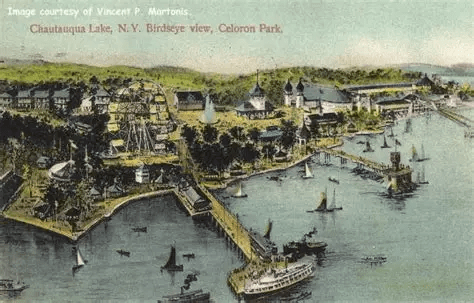
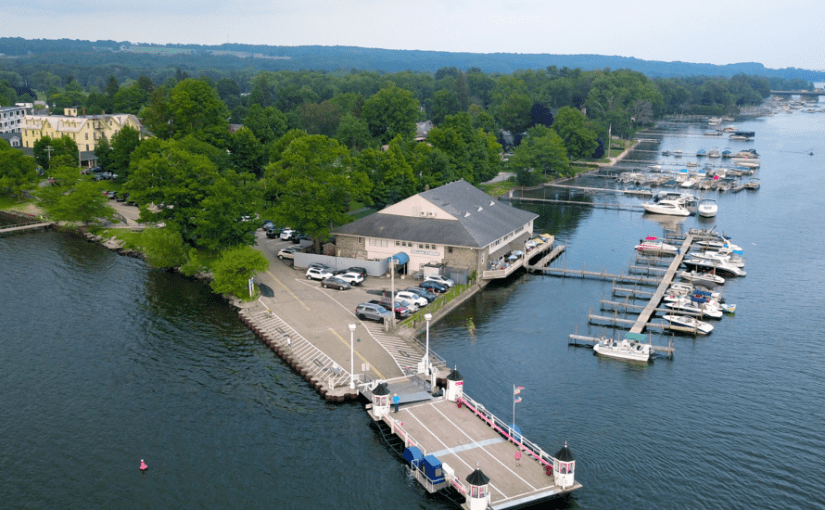
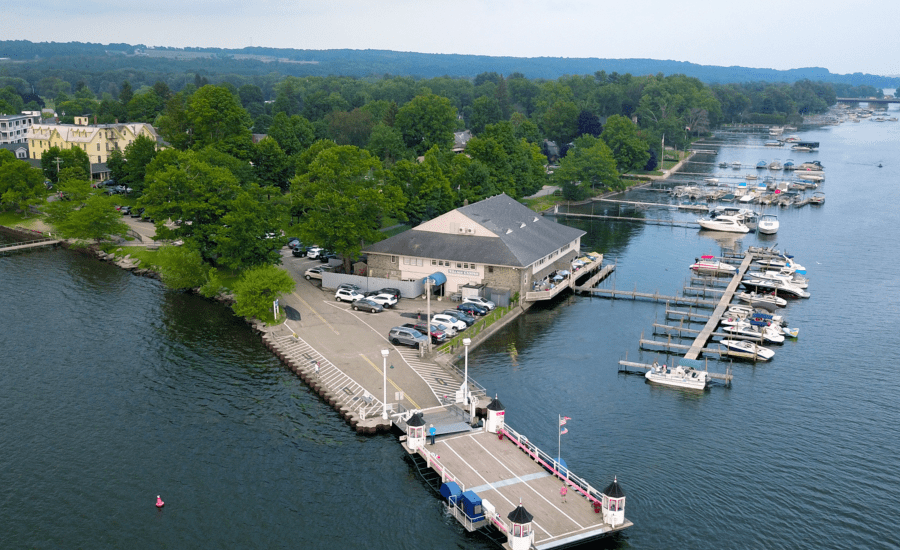
It’s a behemoth, “The Casino”, sitting lakeside like a fortress, guarding the middle of Chautauqua Lake on the Bemus side, the natural half-way point for vehicle and boat travel between Mayville and Jamestown, New York, on a prime spit of land. As you enter the narrows from the water, its unmistakable profile welcomes you to the recreation focal point of the lake. It was built in 1930, purportedly on old local Indian tribal meeting grounds, next to the Bemus Village Park. Pittsburgh industrialist James Selden had the recreation center constructed for the Village of Bemus Point, riding the momentum and popularity of the Celoron Park movement, huge hotels rimming the lake and steamboats transporting people up and down Chautauqua. Like the Celoron pavilion, he equipped it with a dining presence, a dance hall, and bowling alleys on the second floor. During the 1930’s and 40’s that building was one of the most “if these walls could talk” venues in all of New York State.

Through the years, The Village Casino has gone through several iterations, but always comes back to defining itself as a place for food, drinks and entertainment. In the fifties and sixties, it had a carnival park atmosphere as a beach house and bowling alley. In the 80’s, back to a bar and restaurant, accessible by lake traffic. Entertainment picked up again and the facility hosted popular bands like Rusted Root and The 10,000 Maniacs.

And then came the chicken wings.

In 1982, as the wing became popular in Western New York as a meal, rather than waste, the Casino jumped on that phenomenon. At least 14,819 chickens sacrificed the gift of flight so that 29,638 of their wings could be eaten in a twenty-four-hour period. It was a Guinness World record at the time and restored Bemus Point on the map of popular culture, if only that particular slice that enjoys a spicy chicken wing and eccentric world records.

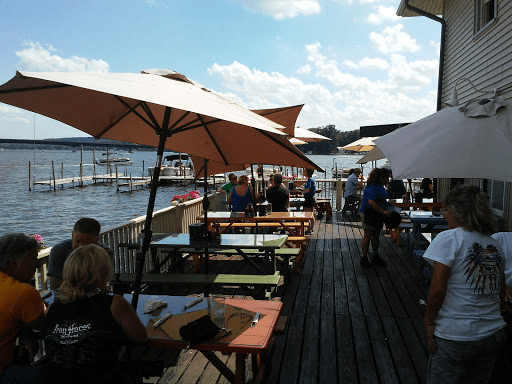
In 1999 the Carlson family took charge of the restaurant, bar and entertainment. They did a comprehensive remodel, added a game room, ice cream parlor, a deck for lake-side dining of about 120 guests, inside and bar seating for another 200. There are forty dock slips and wait-staff restaurant service right out to your boat. The banquet hall where the legends from the past performed is available for events and seats another 300.

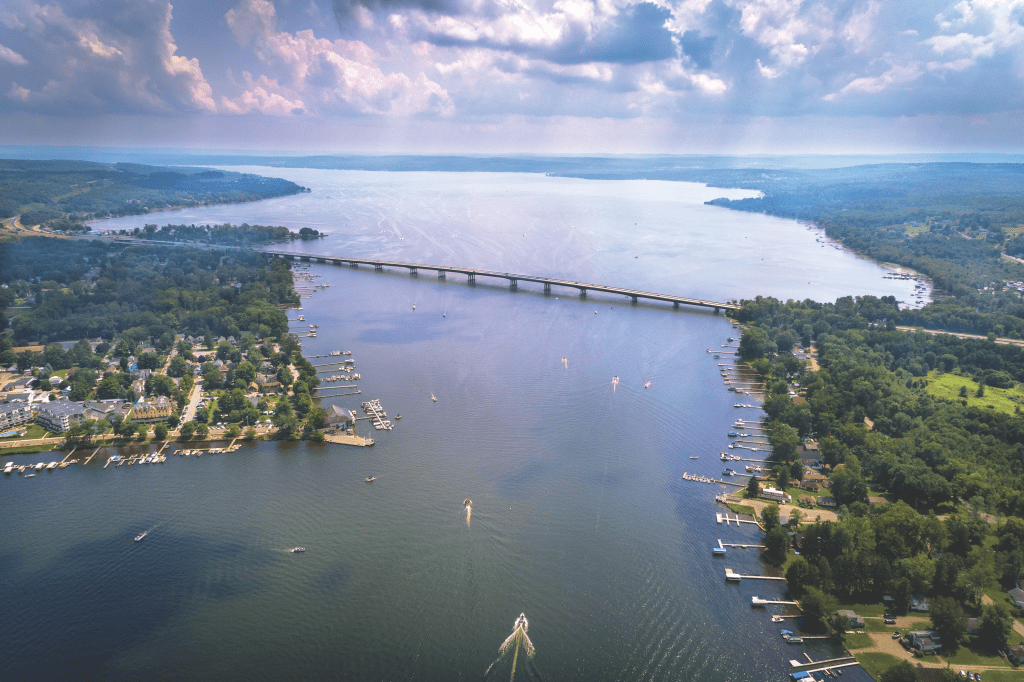
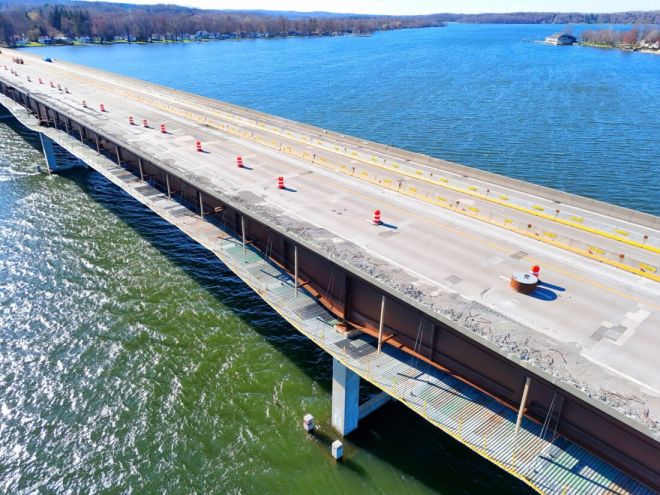
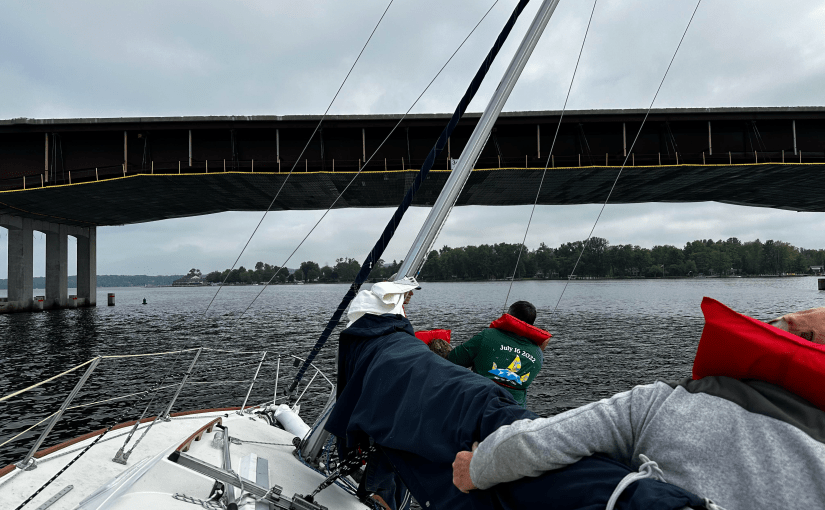
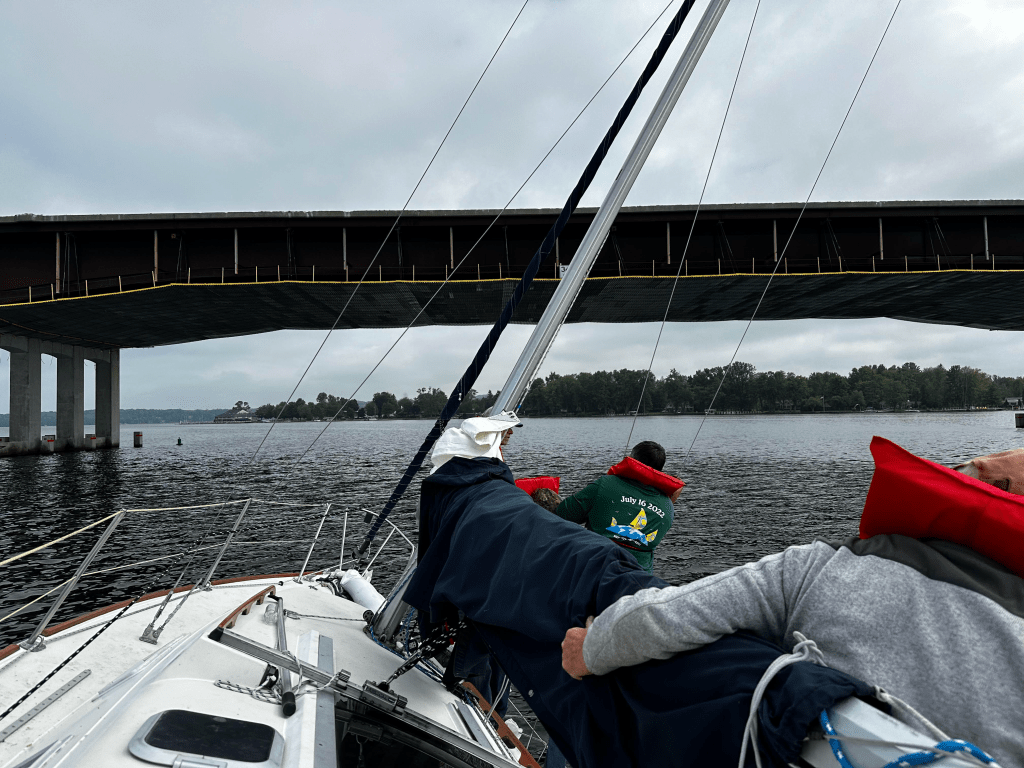
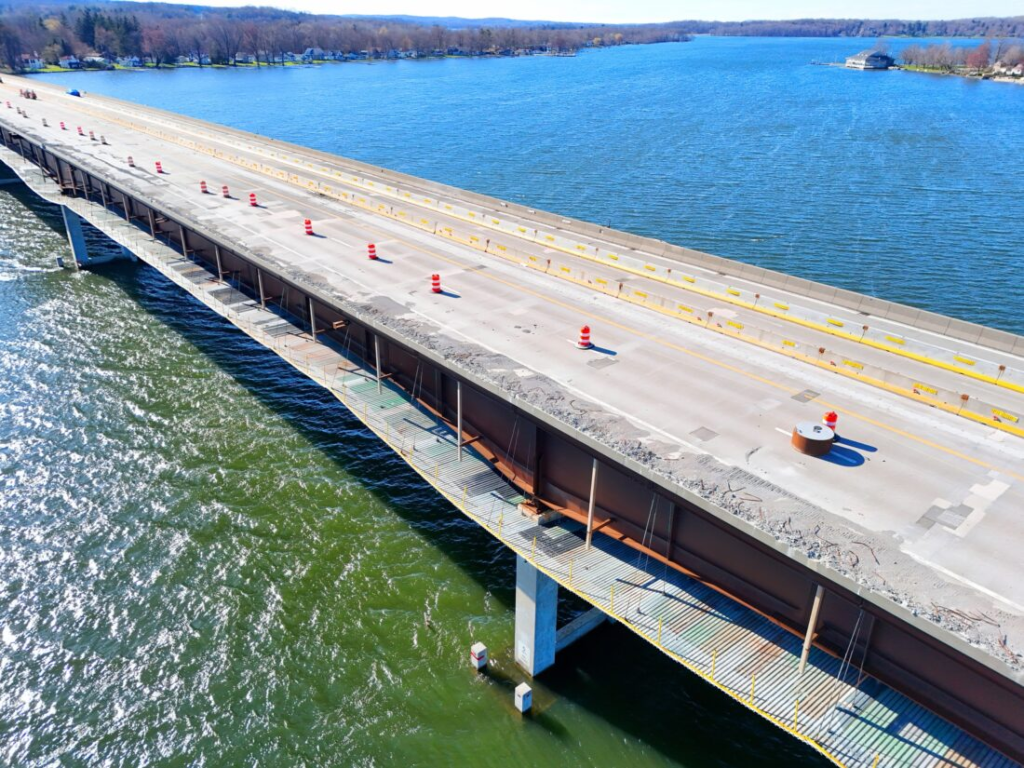
Bemus Point has been the summer entertainment mecca on Chautauqua Lake for decades. It’s the product of its central location, especially with the Veterans Memorial Bridge as an east-west access conduit. The Village Casino has served as the anchor for Bemus, sitting hard on the shores with a rich history of service to patrons that stretches back as far as can be remembered.

It’s owned and operated by local entrepreneur Andrew Carlson, and still hosts live entertainment by local and regional acts every Friday and Saturday evening through Labor Day. As their web site states: We continue our commitment to be the area’s best and most affordable in casual waterfront dining, with an environment that allows you to relax, enjoy, make new friends, and reacquaint with old friends!

The Village Casino is located at 1 Lakeside Drive in Bemus Point. For more information call 386-2333 or visit www.bemuspointcasino.com.

Postscript: In 2018, when the sober esteem of 1982 Guinness record had worn off, the Carlson family served up another 42,210 chicken wings breaking their own record. It was not a good day for poultry in Chautauqua County.

IT’S THE TEETH!!

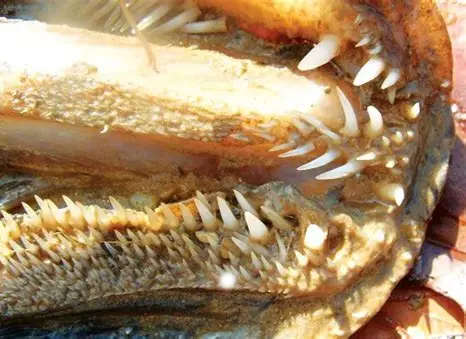
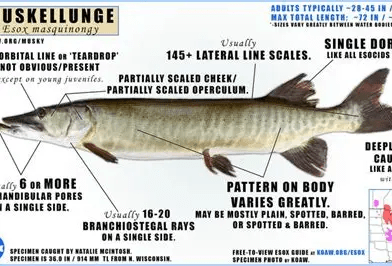
It’s the teeth. And that jutting jaw, the epitome of arrogance and brutish malice. Long muscular torso, thick in the middle, piercing, uncaring eyes. Bigger, stronger, faster than everyone else.

But the teeth. You notice immediately, five hundred at least, more in some of the larger beasts. The fangs are tightly positioned, small and needle-like, angled inward to keep prey from escape, razor sharp to shred live food that struggles.

     Then there’s the behavior, predatory, vicious, lurking, springing from the weeds, leaping to attack and eat the first thing that moves, carnivorous, cannibalistic, devouring its own kind if opportunity presents, even the metal of something man-made, it simply doesn’t care in its frenzy to feed. There’s no discretion, no apologies. It’s hungry, it eats, a notoriously fierce fish (anglers say it will attack the propeller of a trolling motor, while every other life form in the lake will swim from it.

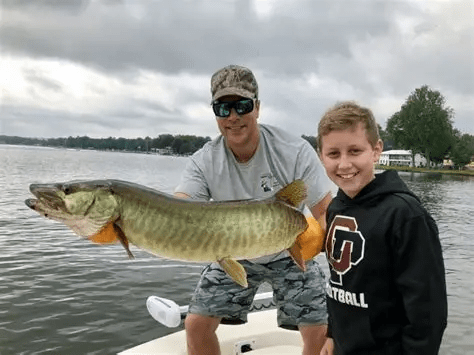
Todd Young has been chartering muskie expeditions on Chautauqua Lake for eighteen years, hosting bucket-list enthusiasts from all over the country looking to battle the largest member of the pike family; catching a muskellunge is that much of an adventure on Chautauqua Lake. It’s a daunting, wildly rewarding industry (the nickname of the muskie is “The Fish of 10,000 Casts”). Todd knows every square quad of Chautauqua Lake. He knows the water; he knows the fish.      

     “We go where the fish are, lower lake, upper basin. I’ve taken hundreds of people onto the lake to catch muskie.”

Dude knows his fish, especially the prize catch on Chautauqua Lake, the muskellunge.
Muskie are intentionally established on Chautauqua Lake (one subspecies is named The Chautauqua Muskellunge). Muskie management became a thing in the late 1800s, when the first hatcheries in the country were built along the shores near Bemus Point. The local hatchery effort, overseen by the state DEC, is now located at Prendergast Point. It’s a calculated process stocking the lake with an apex predator. In 2022, 13,000 fingerlings from six to nine inches long were released into the lake, understanding that about a third of those will survive a season; too many muskie eating the fish supply could seriously disrupt the lake ecosystem. That management, and the general stewardship from fishing charters like Todd’s Muddy Creek Fishing Guides has made the 13,000 acres of Chautauqua Lake a premier muskie fishing destination.

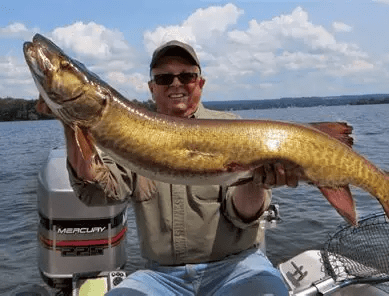
     “We are completely catch and release,” Todd says. “There are fish we catch that I recognize that I’ve caught before. We’re very careful about bringing them onto the boat. We only fight them for a few minutes, it can be a great battle they’re so big and strong, but if you exhaust them you might kill them.”
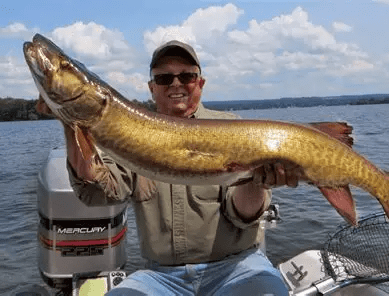
And muskie get big, it’s not uncommon to pull in one thirty-five pounds or more. The largest on record was sixty-nine pounds, fifteen ounces, average usually less than forty inches long and might weigh from seven to fifteen pounds. Muskie can live up to thirty years.

     “We use heavy equipment, put six lines in the water, and hope to average two catches a day.  There’s a small window for catching them when they are in a feeding cycle. Once they’ve eaten, sometimes up to twenty percent of their body weight, they sit still for up to five days digesting. But when they eat, they are very aggressive.

     During their feeding cycle, they’ll eat other fish up to a third of their own size. More than once I’ve seen one floating on the lake that tried to eat another fish that was just too big. They’re not particularly smart fish, when it’s time to eat they don’t much care what they go after.”

Todd thinks the lake has seen a bit of a resurgence, more fish are living longer, getting bigger. “We were seeing red spots on the fish the past few years, an unhealthy sign. We don’t see that on catches now. A four-footer can be twenty years old. That takes a lot of care from fishing to get one to be that old. But that’s the future of our lake, fishing for sport and letting them go.”

You could spend a worse day on Chautauqua Lake than in the care of Muddy Creek Fishing Guides. Check them out at https://mcfishnguides.com), or give Todd a call at 724 674-3839.

A Really Good (not Great) Lake

In the northern part of Chautauqua County, between the lake there and the Great Lake Erie, there’s a place where the earth curves. Actually, there’s many such hills, but this one’s special.

The Chautauqua Ridge is a demarcation of confluence. It plays a small part in splitting the continent in half, between north and south. It’s a rare geological marvel, and it’s right here, where we live. The old saw goes that if there was a building built in the middle of the ridge, that rain falling on the north side would end up in the Atlantic Ocean (Lake Erie to the Saint Lawrence Seaway), and a rain falling on the south side would eventually be deposited in the Gulf of Mexico (Chadakoin to Conewango Creek, Allegheny, Ohio and Mississippi Rivers, past New Orleans into the gulf).

Along that southern route is Lake Chautauqua.

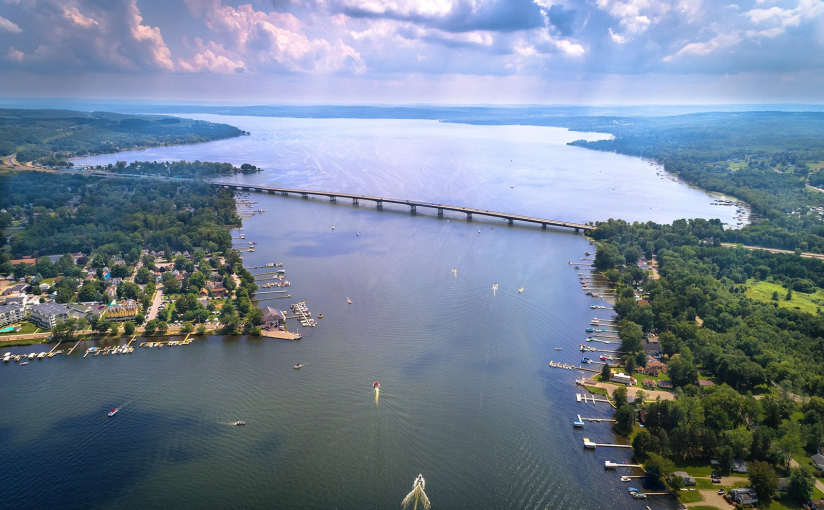
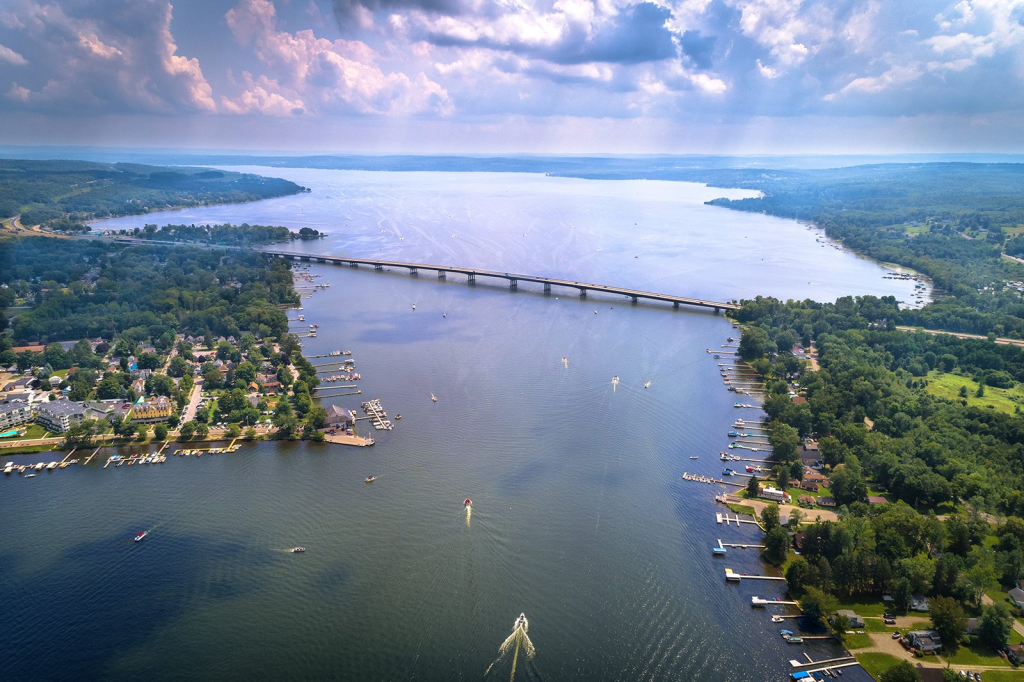
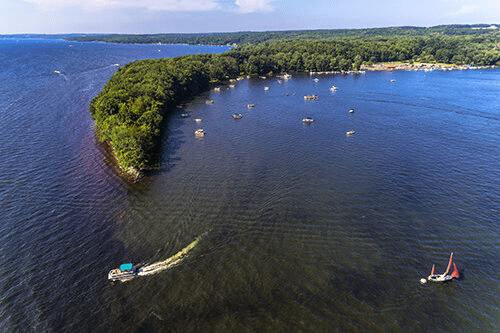
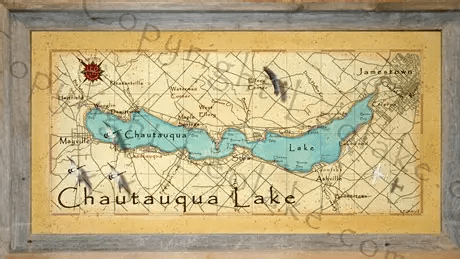
Chautauqua is fed by a dozen or so arterial creeks (Ball, Bemus, Big Inlet, Dewittville, Dutch Hollow, Goose, Lighthouse, Little Inlet, Maple Springs, Mud and Prendergast). At its widest Chautauqua is about two miles. It has a northern and southern basin that squeeze together roughly in the middle. The narrows at Stow and Bemus Point is where the lake is most bridgeable, crossed now New York Interstate 86, and by the Bemus Point ferry on the water. The lake is 17-miles long, a straight-line run from Mayville to Celoron. About forty-one miles is lakefront property, all but about three miles of that privately owned.

     Most people who live on the lake have an attitude of stewardship toward this valuable local resource. It is a prized geological, glacial-built wonder. It is a beacon, and a challenge. The beacon part is obvious, a recreation designation for boaters, fishermen and fisherwomen, and all the entertainment that goes with an easily navigable, accessible body of water.

The challenge? Well, that’s a little more complicated.

The reliance on a lake for the overall financial health of a population can be tenuous. Currently Chautauqua Lake provides the money, the resources, the sustenance of life for much of the south-county population (intermixed with agriculture and manufacturing to be sure). According to the Chautauqua County Office for Media Information, sixty-six percent of visitors to the county use the lake, raising just over $282 million a year. Lakeside municipalities reinvest about $3.2 million back into the lake. The rest of the revenue helps keep businesses open and food on tables via hospitality commerce, and taxes (about 47% of county sales tax is generated annually by lake-border municipalities).

The natural evolution of lakes, what becomes of them in geological timeframes, is that they become forests. Just as water seeks its level, so does the earth. It’s a function of gravity pulling everything down to the lowest points available. Lakes fill in, that’s their natural lifecycle. Runoff from watersheds brings silt and seeds and debris. It settles into the deeper parts of any body of water. Human beings have always been hard on lakes. They invariable get used by populations as depositories for waste. Developing land around lakes, usually the most attractive property, strips a lake of its watershed vegetation and replaces it with construction and chemical residuals. Man-made chemicals cultivate lake weeds that are usually harmful to lake-life.

But as much as man can contribute to the decline of a lake, so can we delay that process, and Chautauqua has champions, people who care for it. Randy Holcomb has been professionally involved with the area around the lake for 47 years (38 in the town assessor’s office and the past nine on the Lakewood Village board). Safe to say he has a feel for the health of the lake, and he is confident in the future of the lower basin as an entertainment and recreation resource. “We welcome the challenge of maintaining lake as a great place to live and visit, Lakewood and Celoron in particular.” His enthusiasm for the future of the lower basin is infectious. “Last year was one of the best we’ve had on the lake in a few years. We’re looking forward to another great summer.”

Chautauqua Lake isn’t in jeopardy of filling in any time soon.

The Grape Discovery Center of Westfield, N.Y.

“Studying wine taught me that there was a very big difference between soil and dirt; dirt is to soul what zombies are to humans. Soil is full of life, while dirt is devoid of it.”

Oliver Magny – Wine expert, author and entrepeneur

Wine making depends on soil quality; you know where the good soil is by what you can grow. Different soils lend themselves to different vintages of wine. Places like NAPA Valley, with its diverse climate, 68 square miles tucked between the Mayacamas Range to the west and the Vaca Mountains on the east is an obvious choice. So too the Finger Lakes in central New York.

On the coast of Lake Erie generally, and in Chautauqua County between Dunkirk and Ripley specifically, the soil is prime for the concord grape, and the wine you can make from it.

The Lake Erie wine region is a hidden gem in American viticulture. Spanning parts of Ohio, Pennsylvania, and New York, hugging the coast of the great lake, it’s distinguished by its unique climate, soil composition, and geographical location, creating an ideal environment for wine production. The concord grape, with its deep root system thrives here. Lake Erie keeps the local weather from extreme fluctuations (though you would be hard pressed to convince local snow-belt survivors of that), which allows for a longer growing season and relatively stable conditions for the concord grape.

In recognition of the importance, and economic impact of this region as a wine mecca, the Grape Heritage Foundation constructed The Grape Discovery Center In February 2010.

“We consider ourselves the educational and historical center of the Lake Erie grape corridor,” says Deb Howser. “There are thirty-thousand acres of vineyards in a hundred-fifty miles along the lake.” Deb is the manager of the Discovery Center. “Here we have representations of most of the products from those vineyards. We are able to sell quite a few of the wines from New York State, and we showcase those from Pennsylvania.”

The Center is an inauspicious building, located slightly off the beaten path on Route 20 off New York State 90 between Westfield and Ripley, N.Y. From the roadside it’s an unassuming building, but a revelation inside. It features a tasting bar with wines from the area, an exhibit room, interactive learning displays, and a souvenir shop with apparel, food, and art from local artisans.

The economic impact of the industry is undeniable. With a worldwide distribution of the products from the area, the grape district supports almost 2,000 jobs. The total economic impact is $340 million, which includes sales generated by juice processors, growers, wine production, and and other businesses from whom the vineyards purchase. About $54 million is paid out in wages from over 800 producers on those 30,000 acres of vineyards. Total sales approaches $210 million, with $17.5 from wine production. Some 35,000 tourists visit annually. The center is celebrating its ten-year anniversary.

A premier event for the center is the Westfield Grape and Wine Festival, held at Moore Park in Westfield, N.Y., coming September 7th and 8th. This is the second year of the festival, that has something for the whole family all centered around the grape. “There are grape pies and ice cream as well as the wines and juice.” Howser says. “We’ll have vineyard tours and feature antique equipment.”

Most recently the Center has housed brewing operations for Ghostfish Brewing Company. The Seattle based company has one of the premier gluten free craft beers on the market. The Center will be selling that unique product soon.

Meanwhile, there’s plenty of wine.