ICE ICE BABY

Do a quick thought experiment before reading on.
Make ice without electricity.

Of all the day-to-day comforts we take for granted, the human ability to create cold might be the most underrated (heat was a piece of cake). Refrigeration, other than via of evaporation and air movement, wasn’t invented until the 1830’s. It wasn’t perfected for another century. There is no reliable data that recorded how many refrigerators were in United States homes prior to 1940, but it wasn’t many (by 1944 they were in about half the households).

If you wanted something cold, it meant ice.

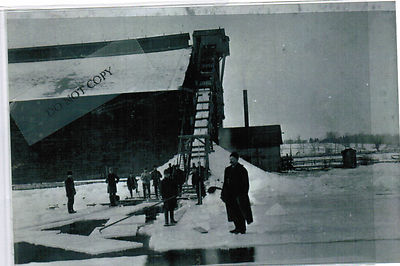
Ice harvest on Chautauqua Lake was a boom business from the 1880’s through the 1910’s; twenty to forty-thousand tons removed from the lake yearly and shipped to ice houses, mostly in Pittsburgh, but west to Cleveland and east to Buffalo as well. Ice was a regional industry that moved tens of thousands of tons of product and employed entire work forces through long winters.

Chautauqua Lake has a low shoreline, easily accessible. The upper basin has a depth best for growing ice. By late January every year crews lay out a cutting schedule, dividing the ice into a grid of blocks twenty-two by thirty-two inches, with a depth of twelve to eighteen inches. Blocks weigh between a hundred-fifty and three-hundred pounds. Giant saws cut up the grids and horse-drawn sleds pull the ice onto shore. Ice is loaded onto wagons and transferred to train stations.       The blocks are standardized to maximize storage. A single railcar can carry thirty to forty tons of tightly packed ice, and during the busiest weeks, multiple cars depart daily for industrial centers. Ice from Chautauqua Lake is known throughout the east for its clarity and slow melt rate, qualities that reduce losses during transport and increase its commercial value. A block of Chautauqua ice can last ten to twelve months if stored correctly.
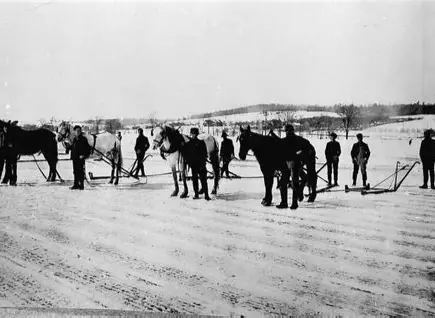
The Celoron Ice Company and facilities in Mayville maintained storage capacity for more than ten-thousand tons, not simply stacks of frozen water, but inventory, revenue, and the wages of hundreds of workers. Families depended on the harvest to bridge the financial gap between fall and spring.

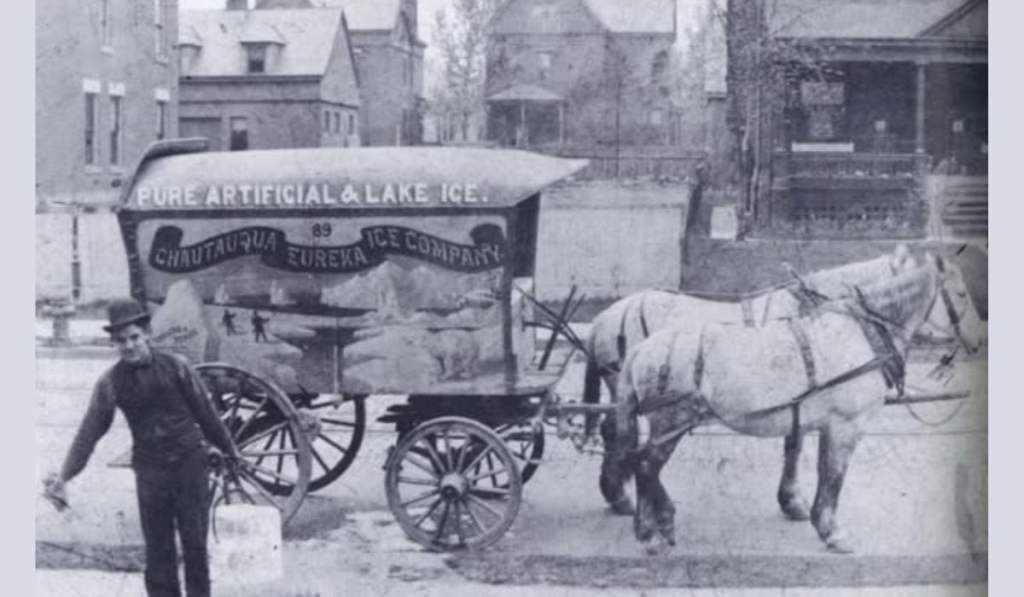
But the industry operated on narrow margins, dependent on the weather. A solid freeze determined whether a year would be profitable. Mild winters, or untimely thaws, could ruin an entire harvest season, which trickled down to all the industry that counted on ice, including service to individual homes. This ice had to last until the next freeze and provide winter wages for ice workers, wages that were comparatively strong for the era—often $1.50 to $2.00 per day when factory work paid closer to $1.00.

Icehouses were feats of practical engineering. The Celoron structure was a massive wooden complex along the shoreline, insulated heavily with sawdust (sawdust was the perfect insulation, a limited conductor of heat, and cheap), it could preserve ice into September. Storage capacity was precise, every cubic foot represented potential income. A fully stocked icehouse could hold a value equivalent to hundreds of thousands of dollars in today’s dollars.
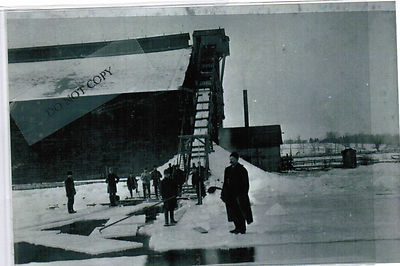
Before rail expansion, natural ice rarely traveled far from its source. Afterward, it became a critical component of food distribution, brewing, and industrial cooling across multiple states. Thousands of tons left the Chautauqua Lake with breweries among the largest consumers.

By the 1920s mechanical refrigeration technology began to offset the ice industry. Prices for natural ice, once $4 to $6 per ton, fell to $1. Profit margins collapsed. Icehouses that had operated for decades closed, buildings were dismantled, equipment was sold for scrap, and workers moved into factories, railroads, and other emerging industries. The transition happened quickly enough that many communities experienced it as a sudden end rather than a gradual decline. Chautauqua County was no exception, but in its halcyon days, frozen water from the lake was a major local business.

SPORT IN JAMAICA

(First published March 2018)

If you ever doubt the global blanket of sports television, just know there’s something called ESPN Caribbean.  There’s and ESPN Asia, Australia, Brazil, and ESPN-UK too.  To my research there is no ESPN-Siberia yet. The ESPN Caribbean network airs in 32 countries, including one I visited recently.  ESPN Caribbean SportsCenter in Jamaica features sports like America’s Cup yacht racing, grand slam tennis, a little golf, something called Netball (the “Jamaican Sunshine Girls” team is currently ranked third in the world), and a whole lot of soccer and cricket.  There is most certainly MLB, NBA and NFL action, but not before you wade through scores and highlights of the Caribbean Premier League, the Caribbean Super 50, the Karbonn Smart League, the English Premier League, German Bundesliga, Spanish La Liga, Italian Serie A Soccer, and the uber-important International Cricket Council with its wickets, nurdles, and wicked googlies.  If I could name a single famous cricketer, Jamaican or otherwise, I would do it here.  I can’t, but I do know that Patrick Ewing was born in Kingston, Jamaica and excelled at that game along with soccer.  Jamaican icon Bob Marley was supposed to be excellent on a football pitch.

Usain Bolt currently dominates the Jamaican sports scene, as much as a single athlete can; the fastest human in the history of the world will tend to capture the attention of the nation in which he has born. 

He is relatively absent in the media, as Jamaicans seem to love their sports and sporting action more than they worship their sportsmen and women.  Bolt adorns a few roadside billboards, shilling for cell services and energy drinks, but other than that he’s not as ubiquitous as you’d think.  Opposite of the U.S. where we tend to define the performance by the performer, and an athlete like LeBron James can shake the rust off the belt of a once-proud city like Cleveland with one moving van full of sneakers, tank tops, and elbow pads (c’mon Buckeyes, he didn’t cure cancer, he plays basketball).  On a short bus trip from Montego Bay (the inspiration of The Beach Boys, Bobby Bloom and Jimmy Buffet) to Falmouth in Trelawny Parish (where James Bond jumped a speed boat onto a cop car) our tour group passed Bolt’s high school, what are the odds? Ben Johnson, incidentally is infamously from Falmouth also, must be something FAST in the water there.  The fact of that coincidence was startling until you realize that there are only 2.7 million-some people on the island spread out over 4,244 square miles, a good two-thirds of it coastal and accessed from the main highway; not exactly like landing in Los Angeles and randomly driving by the White House.

The Jamaican Bobsled team famously competed in the 1988 Calgary Olympics Winter Games.  Disney made a movie about them called Cool Runnings, and that name is plastered on everything from convenience stores to jet-ski rentals shops. 

Side note, renting jet-skis is against the law in Jamaica because tourists kept smashing into each other on them.  As you’d imagine on a Caribbean island (where the ocean water temperature in August is a squishy 97 degrees by the way), water sports are plenty, the moratorium on wave-runners notwithstanding; scuba diving, windsurfing, sailing, waterskiing, snorkeling, parasailing, and deep sea fishing.

The poverty in a Caribbean country like Jamaica registers when you internalize the fact that it can’t snow there.  No population could survive a frigid climate in homes with so few amenities, like running water, a workable furnace and, often, walls and floors.  I found myself and my family being escorted up the North Coastal Highway in a local taxi, from Negril to Mon-Bay.  We were escorted by friends of a friend, real Rasta’s, dreads and all.  The view was postcard tropical, blue-green ocean waves crashing on beach-heads and cliff sides.  We stopped at a roadside shack, one of many, for something cold to cut into into the tropical heat.  Our guides knew the place.  They talk with the proprietor.  Jamaicans speak English, until they don’t want you to understand them, then they speak something that isn’t English.  Soon were sipping water from a raw coconut, and a mango concoction from a plastic cup.

I wander out of the broken-down bar, all particle board and corrugated tin.  There along the roadway two kids are kicking a half flat soccer ball in a dirt driveway. Yeah, they like their sports in Jamaica.  I lace up my shoes and join in.

IT’S THE TEETH!!

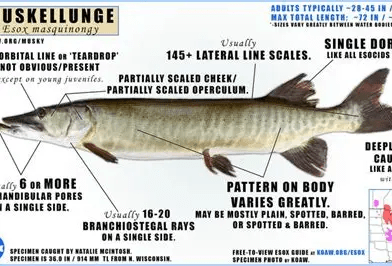
It’s the teeth. And that jutting jaw, the epitome of arrogance and brutish malice. Long muscular torso, thick in the middle, piercing, uncaring eyes. Bigger, stronger, faster than everyone else.

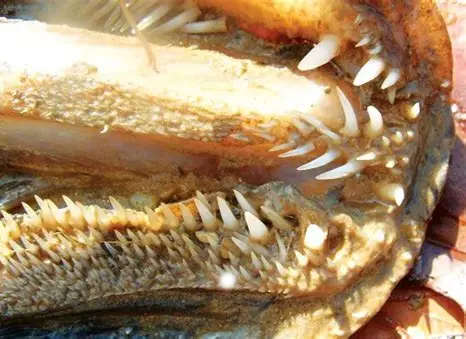
But the teeth. You notice immediately, five hundred at least, more in some of the larger beasts. The fangs are tightly positioned, small and needle-like, angled inward to keep prey from escape, razor sharp to shred live food that struggles.

     Then there’s the behavior, predatory, vicious, lurking, springing from the weeds, leaping to attack and eat the first thing that moves, carnivorous, cannibalistic, devouring its own kind if opportunity presents, even the metal of something man-made, it simply doesn’t care in its frenzy to feed. There’s no discretion, no apologies. It’s hungry, it eats, a notoriously fierce fish (anglers say it will attack the propeller of a trolling motor, while every other life form in the lake will swim from it.

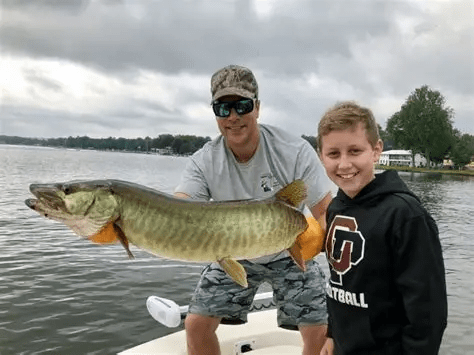
Todd Young has been chartering muskie expeditions on Chautauqua Lake for eighteen years, hosting bucket-list enthusiasts from all over the country looking to battle the largest member of the pike family; catching a muskellunge is that much of an adventure on Chautauqua Lake. It’s a daunting, wildly rewarding industry (the nickname of the muskie is “The Fish of 10,000 Casts”). Todd knows every square quad of Chautauqua Lake. He knows the water; he knows the fish.      

     “We go where the fish are, lower lake, upper basin. I’ve taken hundreds of people onto the lake to catch muskie.”

Dude knows his fish, especially the prize catch on Chautauqua Lake, the muskellunge.

Muskie are intentionally established on Chautauqua Lake (one subspecies is named The Chautauqua Muskellunge). Muskie management became a thing in the late 1800s, when the first hatcheries in the country were built along the shores near Bemus Point. The local hatchery effort, overseen by the state DEC, is now located at Prendergast Point. It’s a calculated process stocking the lake with an apex predator. In 2022, 13,000 fingerlings from six to nine inches long were released into the lake, understanding that about a third of those will survive a season; too many muskie eating the fish supply could seriously disrupt the lake ecosystem. That management, and the general stewardship from fishing charters like Todd’s Muddy Creek Fishing Guides has made the 13,000 acres of Chautauqua Lake a premier muskie fishing destination.

     “We are completely catch and release,” Todd says. “There are fish we catch that I recognize that I’ve caught before. We’re very careful about bringing them onto the boat. We only fight them for a few minutes, it can be a great battle they’re so big and strong, but if you exhaust them you might kill them.”

And muskie get big, it’s not uncommon to pull in one thirty-five pounds or more. The largest on record was sixty-nine pounds, fifteen ounces, average usually less than forty inches long and might weigh from seven to fifteen pounds. Muskie can live up to thirty years.

     “We use heavy equipment, put six lines in the water, and hope to average two catches a day.  There’s a small window for catching them when they are in a feeding cycle. Once they’ve eaten, sometimes up to twenty percent of their body weight, they sit still for up to five days digesting. But when they eat, they are very aggressive.

     During their feeding cycle, they’ll eat other fish up to a third of their own size. More than once I’ve seen one floating on the lake that tried to eat another fish that was just too big. They’re not particularly smart fish, when it’s time to eat they don’t much care what they go after.”

Todd thinks the lake has seen a bit of a resurgence, more fish are living longer, getting bigger. “We were seeing red spots on the fish the past few years, an unhealthy sign. We don’t see that on catches now. A four-footer can be twenty years old. That takes a lot of care from fishing to get one to be that old. But that’s the future of our lake, fishing for sport and letting them go.”

You could spend a worse day on Chautauqua Lake than in the care of Muddy Creek Fishing Guides. Check them out at https://mcfishnguides.com), or give Todd a call at 724 674-3839.