“In the world of Stones, every landscape is a canvas for adventure. From the soft, shell-strewn sands of beaches to forests blanketed in pine needles and twigs, to the manicured charm of mowed meadows and diverse soil terrains – diversity is our playground. We embrace the unconventional, where slopes, hills, and rugged cliffs become the backdrop for an exhilarating Stones experience.”
Stones Throwing Association Website

The game of Stones is easy to describe and hard to picture. The nearest recognizable relative is probably bocce; a small ball is set on a fixed piece of earth, and alternating competitors toss heavy baked-clay balls at the target, trying to get closest. But it’s like bocce in the same way shuffleboard is like golf.
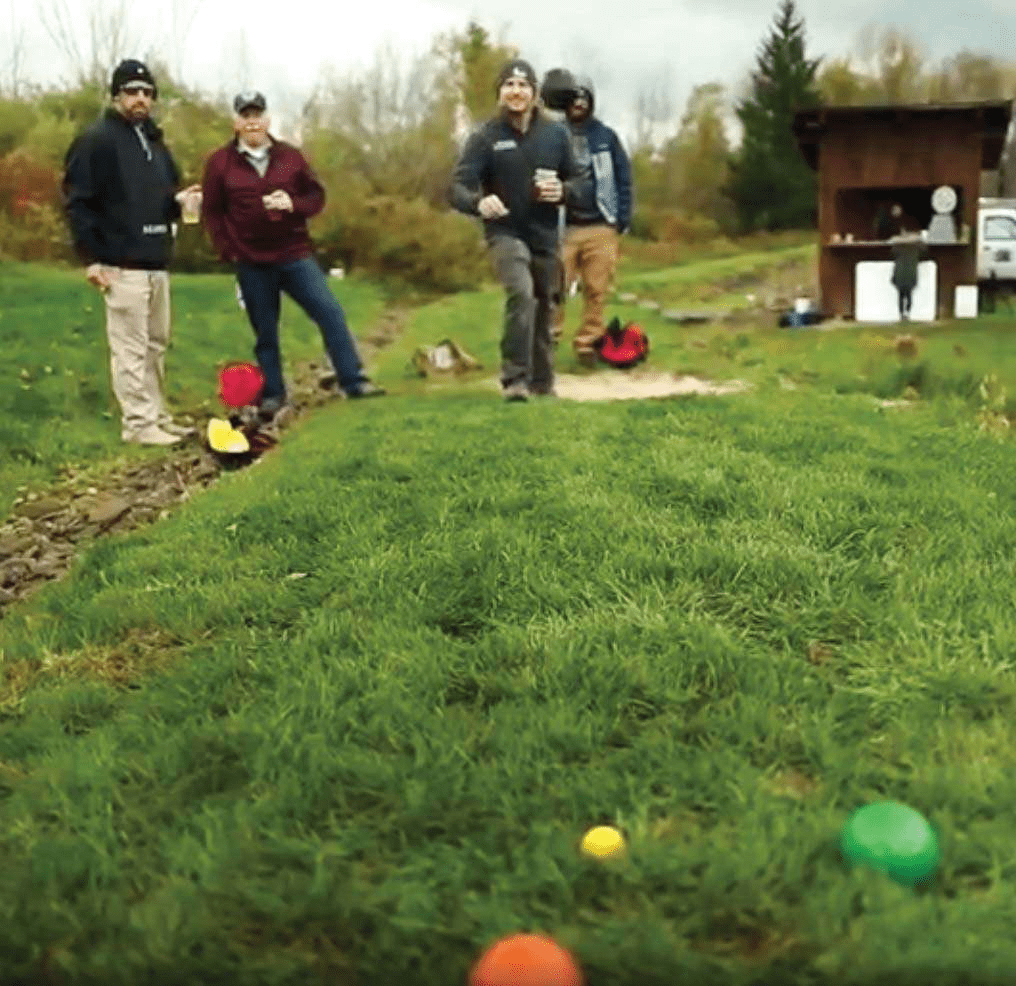
So, Stones is more like golf? Not exactly. It has elements of golf, in that there is a fixed course, with fairways and hazards, out of bounds, and management strategies. But it’s more like putt-putt blended with bowling than the golf you know.
Kade Sivak is the COO of the Stones Throwing Association and manages the course located at the Southern Tier Brewery in Lakewood. It’s a unique recreation operation in Chautauqua County. He says about the game, “What I love most about the game is that it’s accessible, it can be played by people of all ages and still have a great time. We’ve had a tournament where we have an eight-year-old partner with an eighty-year-old and they ended up winning a few games and had a great time.”
A Stones course is five stretches (holes) that take you through mowed fairways, sand traps, and rough patches, around and through trees and stone fixtures, up and down hills. There are clear boundaries on each stretch (sometimes it’s a pool of water!). You play the five stretches, tossing four stones per round -some stretches remind you of golf par threes, some are longer and remind you of a par five. All stretches score the same, you throw your stones, score the stretch and move onto the next, unique challenge. There are sixteen basic rules of play and etiquette, but like golf (which has only a few rules), it’s the interpretations that are abundant…especially when you take balls of any sort into the wild and toss or hit them around.
There. Simple.
And, in Lakewood, it’s played in a beer garden. What could be better than that?
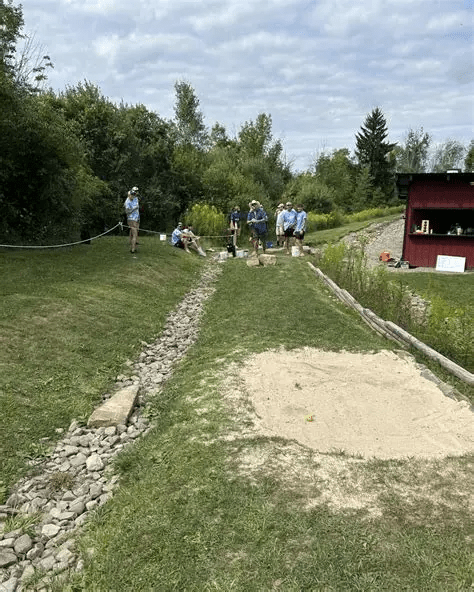
Kade manages the Southern Tier course called Brewers Hollow. “I manage all events like leagues and tournaments there,” Sivak says. Brewer’s Hollow is the first public stones course ever built, constructed by Sivak Stonemasonry. “They work as a course designer and builder for any new courses at other breweries or businesses that want to enjoy the game of Stones. We encourage people if they ever see a place that could fit a Stones course to check out our website and reach out to us so we can attempt to make that dream come true!”
Brewer’s Hollow is the premier Stones venue in, well, the world. “We’ve hosted hundreds of tournaments as well as leagues every summer and fall that fill up quick, but we are always looking to expand and host more players each night,” Kade says. “We have a world championship every year, with last year’s having a cash prize of $1,000. This year we are attempting to take it to the next level and really give people the best experience at each tournament that is planned out this year.
“STA tournaments and leagues are on the website that vary in competitiveness. As well as a team league called the National Stones League, that includes teams like the Buffalo Mafia, the Jamestown Ironmongers, Chautauqua Armada, and the Pittsburgh Chaos. This team league is peak competition as it is a different approach to the game but takes all the best players and faces them off in 8v8 competition.”
Play at Brewer’s Hollow, like most outdoor sports in the area, follows the weather. Kade continiues, “For casual play we will be opening up May 18th on Southern Tier Public Day where we will be offering each new players first game free as well as have the option to have a skilled player help them learn the game. Then we’re open Wednesday through Sunday until the end of September.
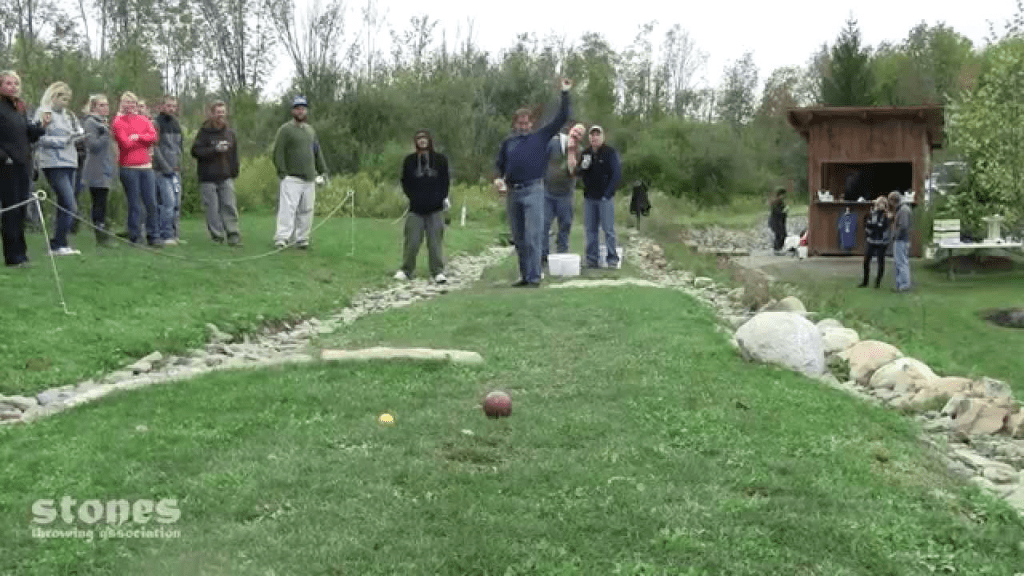
“We’re promoting this year as ‘The Year of Stones’, so if you’ve never played, this would be a good time to come try out the game. It’s easy, fun, and doesn’t take long to play a match. The Stones community is filled with great people that are always willing to help teach new players and it’ll be the best outdoor activity in the area.
You can check out everything Stones at stonesthrowing.com.