Mason Winfield’s

SPIRIT WAY PROJECT

© MASON WINFIELD 2023 SPIRIT WAY PROJECT 2023:

The paranormal expert/examiner/medium/TV personality steps boldly into the house/barn/cellar/church, the one that locals say is haunted, the site that bumps in the night. An audio-visual crew follows diligently. They pack equipment designed to detect the undetectable, to record the mysteries within; a ghostly apparition, a supernatural aura, a sixth sense.

And…CUT

PRINT

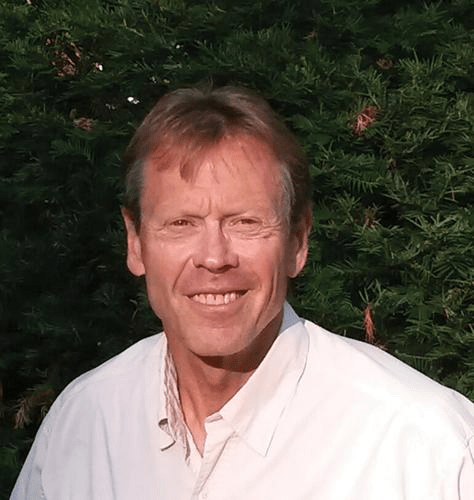
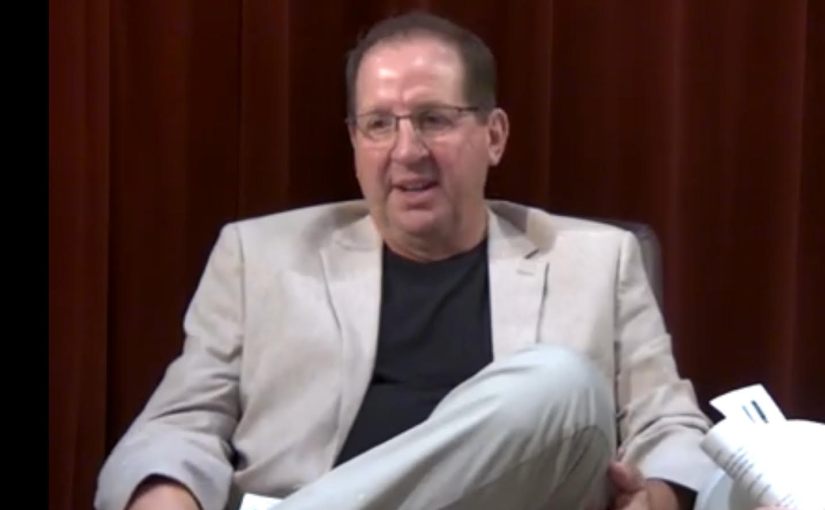
Mason Winfield has a deep and abiding interest in the paranormal. It’s been his life work (as evidenced by his vitae on his website http://www.masonwinfield.com). He’s a lecturer, author, storyteller, scientist. He is not, by his own reconning, a “ghost-hunter.” If there’s a profession that informs and directs his attention and talents, it’s probably best described as “Truth Seeker”.     

He believes it’s time for the industry to innovate, to broaden its influence. “If there’s a possible way to the truth, you have to take it, don’t you?” he says.

To accomplish this, Winfield seeks to employ a field of multidisciplinary professionals, people different in cultural and thematic sensibilities, to explore ancient spaces, areas of the northeastern United States that have universally experienced what he calls “EHE”, Exceptional Human Experiences. “Why do people say they see the thigs in the paces they do?” Winfield asks.    

It’s a query he hopes to answer with The Spirit Way Project.

Designed like the popular European group The Dragon Project, The Spirit Way uses the resources of scientific and paranormal disciplines to research the undeniably interesting and real world of EHE.

Winfield says, “The reality-TV paranormal industry typically studies buildings no more than a century-old–as though haunted sites are sensational and rare, no more original ones can be found, and paranormal sightings occur only indoors. It also barrages us with two perspectives, either intuitive–psychic–insights or surveillance ghost-hunting, as though using electronic and digital instruments as a glorified Ouija board is some objective avenue to the truth–and no other avenues of insight are available.”

Differentiating from the television shows you night have seen, The Spirit Way is basically a two-fold approach to supernatural investigation; using ancient resources to identify sites of EHE that have survived and inspired humans for centuries (think Native American history and collective consciousness), and to coordinate with any and every discipline to develop a coherent and multi-faceted theory of those experiences. So far, the group has employed:

A Feng-Shui Master, an Algonquin Elder, an African-American psychic medium, an author/researcher/paranormalist, a psychologist, two master dowsers, local scholars, historians, anthropologists, geologists, First Nations leaders, aerial surveillance experts, and team of paranormal investigators.

The goal of the team is to examine sites of reported Exceptional Human Experiences through the disciplines of geometry, shape (symbolic form), geology (earth-energies), archaeo-astronomy (an awareness of sunrises, moonrises, equinoxes, and solstices), and alignments across broad stretches of landscape to suggest codes if not messages.

“It’s been a challenge. There are no upstate surveys of supernatural events; national, but not local. All anyone can agree on is that these monuments had sacred function–and that, like Stonehenge and the Great Pyramid and a worldwide league of others, they are paranormal sites. In their proximity, people report exceptional experiences. Just like a haunted house–though vastly grander and more profound–these ancient American sacred sites get a lot of ghost stories.”

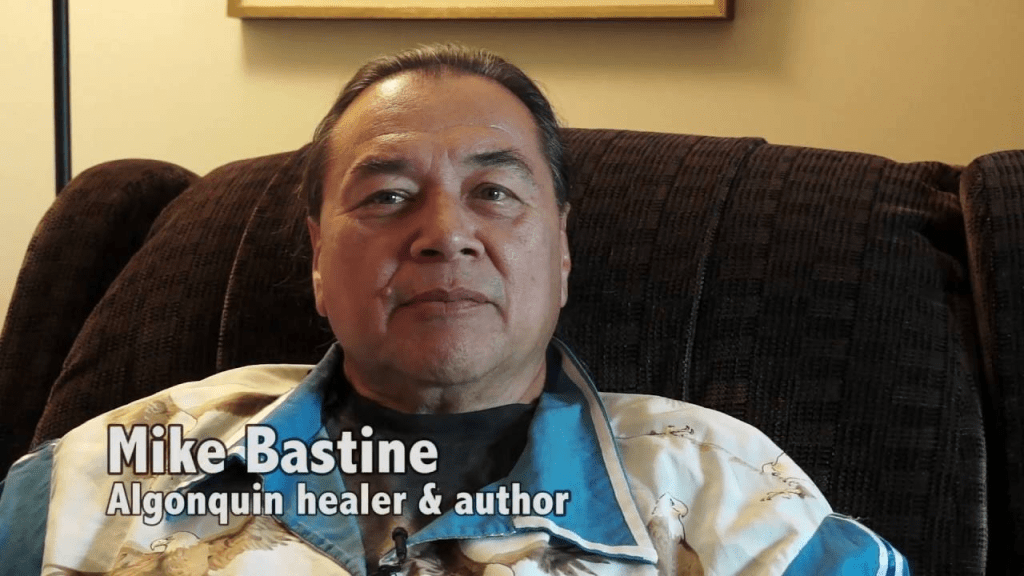
Winfield lives in East Aurora, and understands the newer supernatural phenomenon in Western, New York. Along with his partner, and co-founder of The Spirit Way project, Algonquin Elder Michael Bastine, who Winfield calls one of the best teachers in the world on the subject of native supernatural history, the goal is to broaden the scope of their studies to the ancient world.

“The ancient monuments of the British Isles have been preserved and studied,” Winfield says,” We want to start a new model of north American haunted sites, ancient places, not buildings, hut rather the outdoor sites, real study from different perspectives.”

The Spirit Way will start with a program of fifteen YouTube episodes in New York State.

Winfield concludes, “There is more to the paranormal. The Spirit Way Project (SWP) believes it’s time for a revolution. We think the public thirsts it.”

IT’S THE TEETH!!

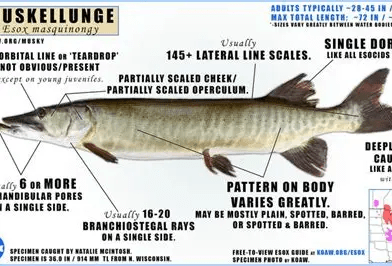
It’s the teeth. And that jutting jaw, the epitome of arrogance and brutish malice. Long muscular torso, thick in the middle, piercing, uncaring eyes. Bigger, stronger, faster than everyone else.

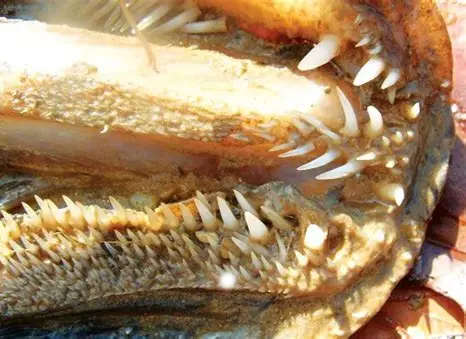
But the teeth. You notice immediately, five hundred at least, more in some of the larger beasts. The fangs are tightly positioned, small and needle-like, angled inward to keep prey from escape, razor sharp to shred live food that struggles.

     Then there’s the behavior, predatory, vicious, lurking, springing from the weeds, leaping to attack and eat the first thing that moves, carnivorous, cannibalistic, devouring its own kind if opportunity presents, even the metal of something man-made, it simply doesn’t care in its frenzy to feed. There’s no discretion, no apologies. It’s hungry, it eats, a notoriously fierce fish (anglers say it will attack the propeller of a trolling motor, while every other life form in the lake will swim from it.

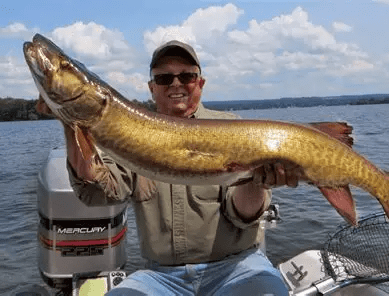
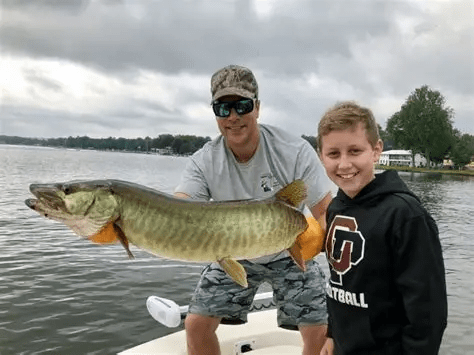
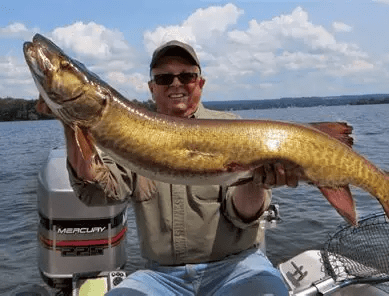
Todd Young has been chartering muskie expeditions on Chautauqua Lake for eighteen years, hosting bucket-list enthusiasts from all over the country looking to battle the largest member of the pike family; catching a muskellunge is that much of an adventure on Chautauqua Lake. It’s a daunting, wildly rewarding industry (the nickname of the muskie is “The Fish of 10,000 Casts”). Todd knows every square quad of Chautauqua Lake. He knows the water; he knows the fish.      

     “We go where the fish are, lower lake, upper basin. I’ve taken hundreds of people onto the lake to catch muskie.”

Dude knows his fish, especially the prize catch on Chautauqua Lake, the muskellunge.

Muskie are intentionally established on Chautauqua Lake (one subspecies is named The Chautauqua Muskellunge). Muskie management became a thing in the late 1800s, when the first hatcheries in the country were built along the shores near Bemus Point. The local hatchery effort, overseen by the state DEC, is now located at Prendergast Point. It’s a calculated process stocking the lake with an apex predator. In 2022, 13,000 fingerlings from six to nine inches long were released into the lake, understanding that about a third of those will survive a season; too many muskie eating the fish supply could seriously disrupt the lake ecosystem. That management, and the general stewardship from fishing charters like Todd’s Muddy Creek Fishing Guides has made the 13,000 acres of Chautauqua Lake a premier muskie fishing destination.

     “We are completely catch and release,” Todd says. “There are fish we catch that I recognize that I’ve caught before. We’re very careful about bringing them onto the boat. We only fight them for a few minutes, it can be a great battle they’re so big and strong, but if you exhaust them you might kill them.”

And muskie get big, it’s not uncommon to pull in one thirty-five pounds or more. The largest on record was sixty-nine pounds, fifteen ounces, average usually less than forty inches long and might weigh from seven to fifteen pounds. Muskie can live up to thirty years.

     “We use heavy equipment, put six lines in the water, and hope to average two catches a day.  There’s a small window for catching them when they are in a feeding cycle. Once they’ve eaten, sometimes up to twenty percent of their body weight, they sit still for up to five days digesting. But when they eat, they are very aggressive.

     During their feeding cycle, they’ll eat other fish up to a third of their own size. More than once I’ve seen one floating on the lake that tried to eat another fish that was just too big. They’re not particularly smart fish, when it’s time to eat they don’t much care what they go after.”

Todd thinks the lake has seen a bit of a resurgence, more fish are living longer, getting bigger. “We were seeing red spots on the fish the past few years, an unhealthy sign. We don’t see that on catches now. A four-footer can be twenty years old. That takes a lot of care from fishing to get one to be that old. But that’s the future of our lake, fishing for sport and letting them go.”

You could spend a worse day on Chautauqua Lake than in the care of Muddy Creek Fishing Guides. Check them out at https://mcfishnguides.com), or give Todd a call at 724 674-3839.

A Really Good (not Great) Lake

In the northern part of Chautauqua County, between the lake there and the Great Lake Erie, there’s a place where the earth curves. Actually, there’s many such hills, but this one’s special.

The Chautauqua Ridge is a demarcation of confluence. It plays a small part in splitting the continent in half, between north and south. It’s a rare geological marvel, and it’s right here, where we live. The old saw goes that if there was a building built in the middle of the ridge, that rain falling on the north side would end up in the Atlantic Ocean (Lake Erie to the Saint Lawrence Seaway), and a rain falling on the south side would eventually be deposited in the Gulf of Mexico (Chadakoin to Conewango Creek, Allegheny, Ohio and Mississippi Rivers, past New Orleans into the gulf).

Along that southern route is Lake Chautauqua.

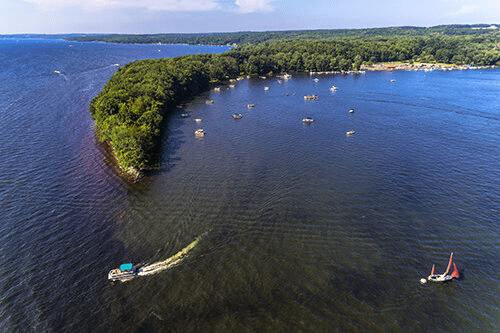
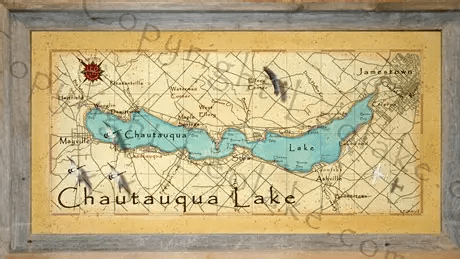
Chautauqua is fed by a dozen or so arterial creeks (Ball, Bemus, Big Inlet, Dewittville, Dutch Hollow, Goose, Lighthouse, Little Inlet, Maple Springs, Mud and Prendergast). At its widest Chautauqua is about two miles. It has a northern and southern basin that squeeze together roughly in the middle. The narrows at Stow and Bemus Point is where the lake is most bridgeable, crossed now New York Interstate 86, and by the Bemus Point ferry on the water. The lake is 17-miles long, a straight-line run from Mayville to Celoron. About forty-one miles is lakefront property, all but about three miles of that privately owned.

     Most people who live on the lake have an attitude of stewardship toward this valuable local resource. It is a prized geological, glacial-built wonder. It is a beacon, and a challenge. The beacon part is obvious, a recreation designation for boaters, fishermen and fisherwomen, and all the entertainment that goes with an easily navigable, accessible body of water.

The challenge? Well, that’s a little more complicated.

The reliance on a lake for the overall financial health of a population can be tenuous. Currently Chautauqua Lake provides the money, the resources, the sustenance of life for much of the south-county population (intermixed with agriculture and manufacturing to be sure). According to the Chautauqua County Office for Media Information, sixty-six percent of visitors to the county use the lake, raising just over $282 million a year. Lakeside municipalities reinvest about $3.2 million back into the lake. The rest of the revenue helps keep businesses open and food on tables via hospitality commerce, and taxes (about 47% of county sales tax is generated annually by lake-border municipalities).

The natural evolution of lakes, what becomes of them in geological timeframes, is that they become forests. Just as water seeks its level, so does the earth. It’s a function of gravity pulling everything down to the lowest points available. Lakes fill in, that’s their natural lifecycle. Runoff from watersheds brings silt and seeds and debris. It settles into the deeper parts of any body of water. Human beings have always been hard on lakes. They invariable get used by populations as depositories for waste. Developing land around lakes, usually the most attractive property, strips a lake of its watershed vegetation and replaces it with construction and chemical residuals. Man-made chemicals cultivate lake weeds that are usually harmful to lake-life.

But as much as man can contribute to the decline of a lake, so can we delay that process, and Chautauqua has champions, people who care for it. Randy Holcomb has been professionally involved with the area around the lake for 47 years (38 in the town assessor’s office and the past nine on the Lakewood Village board). Safe to say he has a feel for the health of the lake, and he is confident in the future of the lower basin as an entertainment and recreation resource. “We welcome the challenge of maintaining lake as a great place to live and visit, Lakewood and Celoron in particular.” His enthusiasm for the future of the lower basin is infectious. “Last year was one of the best we’ve had on the lake in a few years. We’re looking forward to another great summer.”

Chautauqua Lake isn’t in jeopardy of filling in any time soon.