
In the northern part of Chautauqua County, between the lake there and the Great Lake Erie, there’s a place where the earth curves. Actually, there’s many such hills, but this one’s special.
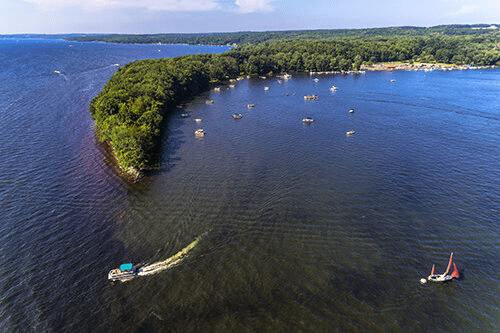
The Chautauqua Ridge is a demarcation of confluence. It plays a small part in splitting the continent in half, between north and south. It’s a rare geological marvel, and it’s right here, where we live. The old saw goes that if there was a building built in the middle of the ridge, that rain falling on the north side would end up in the Atlantic Ocean (Lake Erie to the Saint Lawrence Seaway), and a rain falling on the south side would eventually be deposited in the Gulf of Mexico (Chadakoin to Conewango Creek, Allegheny, Ohio and Mississippi Rivers, past New Orleans into the gulf).
Along that southern route is Lake Chautauqua.
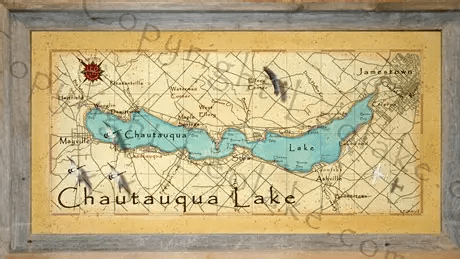
Chautauqua is fed by a dozen or so arterial creeks (Ball, Bemus, Big Inlet, Dewittville, Dutch Hollow, Goose, Lighthouse, Little Inlet, Maple Springs, Mud and Prendergast). At its widest Chautauqua is about two miles. It has a northern and southern basin that squeeze together roughly in the middle. The narrows at Stow and Bemus Point is where the lake is most bridgeable, crossed now New York Interstate 86, and by the Bemus Point ferry on the water. The lake is 17-miles long, a straight-line run from Mayville to Celoron. About forty-one miles is lakefront property, all but about three miles of that privately owned.
Most people who live on the lake have an attitude of stewardship toward this valuable local resource. It is a prized geological, glacial-built wonder. It is a beacon, and a challenge. The beacon part is obvious, a recreation designation for boaters, fishermen and fisherwomen, and all the entertainment that goes with an easily navigable, accessible body of water.
The challenge? Well, that’s a little more complicated.
The reliance on a lake for the overall financial health of a population can be tenuous. Currently Chautauqua Lake provides the money, the resources, the sustenance of life for much of the south-county population (intermixed with agriculture and manufacturing to be sure). According to the Chautauqua County Office for Media Information, sixty-six percent of visitors to the county use the lake, raising just over $282 million a year. Lakeside municipalities reinvest about $3.2 million back into the lake. The rest of the revenue helps keep businesses open and food on tables via hospitality commerce, and taxes (about 47% of county sales tax is generated annually by lake-border municipalities).
The natural evolution of lakes, what becomes of them in geological timeframes, is that they become forests. Just as water seeks its level, so does the earth. It’s a function of gravity pulling everything down to the lowest points available. Lakes fill in, that’s their natural lifecycle. Runoff from watersheds brings silt and seeds and debris. It settles into the deeper parts of any body of water. Human beings have always been hard on lakes. They invariable get used by populations as depositories for waste. Developing land around lakes, usually the most attractive property, strips a lake of its watershed vegetation and replaces it with construction and chemical residuals. Man-made chemicals cultivate lake weeds that are usually harmful to lake-life.
But as much as man can contribute to the decline of a lake, so can we delay that process, and Chautauqua has champions, people who care for it. Randy Holcomb has been professionally involved with the area around the lake for 47 years (38 in the town assessor’s office and the past nine on the Lakewood Village board). Safe to say he has a feel for the health of the lake, and he is confident in the future of the lower basin as an entertainment and recreation resource. “We welcome the challenge of maintaining lake as a great place to live and visit, Lakewood and Celoron in particular.” His enthusiasm for the future of the lower basin is infectious. “Last year was one of the best we’ve had on the lake in a few years. We’re looking forward to another great summer.”
Chautauqua Lake isn’t in jeopardy of filling in any time soon.

 Bill Burk's collective writing...and some other stuff.