You can hear the live readings at https://wjtn.com/podcasts/bill-burk-talks
The Mother, The Son and The Buffalo Bills
When the Bills scored, timely, surprisingly (this was years ago, before the recent resurgence), it propelled them to the NFL playoffs. Finally. It had been awhile. Mid-cheer, the Son looked at his phone, waited for the call. Silent. He frowned, shrugged it off, pushed himself off the stool and celebrated with his friends. Probably busy, he thought. He moved around the bar, high-fived everyone in his considerable reach. Let’s Go Buffalo!
It didn’t completely escape him that the phone didn’t ring. It almost always rang when something good happened in a Bills game. The first seeds of doubt were planted that day, way back in his mind, germinating in the form of sour thought.
Something’s off.
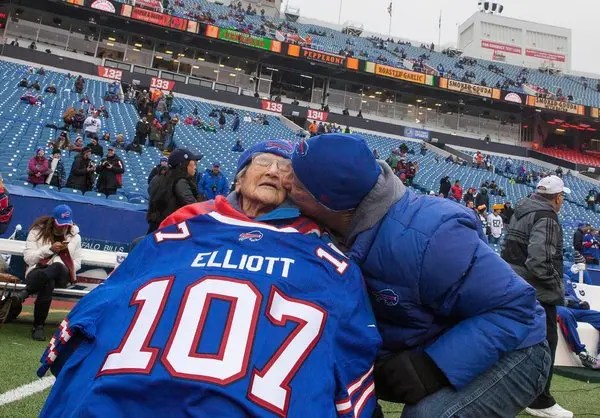
The Son is an enduring fan of the Buffalo Bills national football team, year in year out, roster to roster, coach to coach, one-dimensional classic logo (the profile of a regal buffalo) to three-D Jumbo-Tron videos. War Memorial Stadium (“aka The Rockpile”) to Rich, The Ralph, New Era, and now Highmark Stadium. Joe Ferguson and Juice, the glory days of Reed, Kelly, Biscuit, Thurman and Bruce. The son played both ways in high school, a lineman, so he’s partial to Joe Delamielleure, Kent Hull and Fred Smerlas. He’s a fan of Shane Conlan, played against him in high school. Has replica jerseys, club-head covers, hats, gloves, socks. He models exactly one tattoo, on his arm, conspicuously hidden by a sleeve. It’s an old-school buffalo colored the distinctive red and blue of his favorite football team.
Like a lot of western New Yorkers he’s suffered, rejoiced, suffered and rejoiced again. It’s the way of sports fans everywhere, different for Bills faithful because of how close the franchise has come to perfection. He’s realistic, fatalistic and dedicated. He can pack a living room or a bar with his infectious enthusiasm. He’s the mayor of Bills-Town, USA.
The Mother, also a Bills fan, found in the local team a language she and her football-loving son could share when traditional ways of communication stalled out. It started when he was young, an absent father, and a mother looking for points of contact. It carried into adulthood, common ground, those phone calls every Sunday.
“Did you see that Son?”
“Yes Mom. I saw it.
“Wasn’t it great?”
“Yes it was. It was.”
You can call your child when you need help around the house, an errand run, a chore done. But that’s not nearly the same as calling when you share a visceral moment, even if it happened on T.V., even if you’re sharing over the phone.
“Hang on I have to take this. It’s my Mom.”
Then came that time the phone didn’t ring.
Because we have surety, we can bear existence. We know things to be true, real. We’re confident that we’ll wake to find a familiar world, that we’ll recognize the faces of people in our lives, identify the halls we roam, the rooms we inhabit. We travel our roads without a map, gather wool, positive we’ll arrive at our destination. We know who we are.
When that changes, when the familiar world shrinks and uncertainty creeps into our everyday lives, what do we do? How do we negotiate daily rituals, the grocery store, gassing up the car, Thanksgiving dinner? How do we remember who we are?
Sport is a great match-maker, a conduit for easy communication, a real-time experience to share. It requires only basic understanding, no memory or complicated thinking (it can accommodate those, but doesn’t need it). That’s what makes it a generational conversational structure. You don’t need to recognize a face to celebrate or commiserate a win or loss, you don’t need recall, you don’t need to know where you left your keys to travel, which relative is which, how to mail a letter. You don’t have to track characters or plot. You can sink yourself into moments of feeling, one at a time, as they come and present themselves to you in a blessed solitary series of experiences.
The descriptors of dementia are cliché, there’s no new way to portray it; diabolical and sinister, defiling and brutal, life-sapping, a thief, a hostage-taker. When our veracity slips, how do those left carry on? How do we figure a world where your mother doesn’t recognize your face? Who teaches that class? Physical diseases are certainly hate-able. Curse heart and lung disease, rail against cancer, look it in the face and judge it, name it and fight it. Mental deterioration is an unforgivably insidious betrayal of our capacities, more so because it leaves caregivers to gather the puzzle pieces and sort through them.
We are robbed too soon of our people by disease, accident and catastrophe, they go away plenty fast. We don’t need them pushed from our lives by a memory-starving condition.
The Mother passed recently. It wasn’t unexpected or easy. The day the Bills won and the Son’s phone stayed silent was the first sign of a downward spiral of her faculties, a hole she couldn’t climb from. Rarely, but treasured, she had moments of clarity, when everything was like it used to be. More often she forgot the Buffalo Bills, forgot the Son, familiar people faded in and out of her awareness; here one moment, gone the next. Sometimes replaced by an offset, a memory untethered to reality, sometimes just a hole where recognition should have held.
Inevitably comes that day for all of us when the phone simply doesn’t ring.
For this and more of my writing, please go to www.billburkwrotesomething.law.blog Or check out my book RUN! From Civil War to the NFL; The Jehuu Caulcrick Story, available on Amazon.
Would love to hear from you with a comment or review.










 Bill Burk's collective writing...and some other stuff.