You’re doing it wrong.
I’m doing it wrong too. I don’t remember when I started. It just sort of crept up on me, the way you get hungry after seeing a Burger King commercial. I used to like the best in sports, in athletes. Used to revel in the stories of the games, of the athletes. Used to read the box scores. Then somewhere along the way I lost that. You did too. We were led by the nose into a world of false outrage, forced drama, became weaned on hyperbole; an inexplicable desire to be offended by people we don’t even know.
The pollution has been in news cycles for a while, probably starting when cable TV was invented and the competition for our attention ramped up. It didn’t have to be this way. When programming became a twenty-four-hour cycle of desperate attention-grabs, they could have featured any subject matter to steer our interests, to harvest our awareness. For some reason they chose seamy, belligerent content. News became a competition for who could outrage the most people, up and down the dial.
It’s not our fault, probably has something to do with human nature, or Nixon. Maybe it was the internet.
Sadly, at least from where I sit and watch, the contamination of consumable public media seeped into sports entertainment. Talking heads on sports media report global tragedy as if it’s their place, running in the lane of national news, using their shows about games to share their opinions on super-serious matters.
And we buy in. We scroll past the scores, the highlights, the human achievements, to see who got arrested, who got fined, who’s fired or traded, to decide which professional athlete is more petulant than the next, to gnash teeth over the latest imbecilic thing to come out of the mouth of millionaires who, as a group, aren’t the most fertile source of unique or critical thinking. Reporting of our national games (and that’s what they are, games) used to come as a weekly Sports Illustrated magazine, once-a-week highlight shows, Howard Cosell at halftime of Monday Night Football, the next to last segment on your local news at six broadcast, right before the weather and the closing piece on the local chili cook-off. Now there are entire suites of channeling dedicated to what sports content a producer believes you should see. That’s powerful, heady stuff. And when the Nielson ratings skew negative and provocative, we’re all forced to follow it down the toilet.
There are better uses of your sports entertainment attention. Here’s one.
In 2017 over a hundred Alfred University football players lined up and paraded past nurses to be part of a cause called the Be A Match registry, stopping briefly to have their mouths swabbed for samples. The players and other volunteers hoped that their DNA would match someone on the other end of the registry who needed a bone marrow transplant.
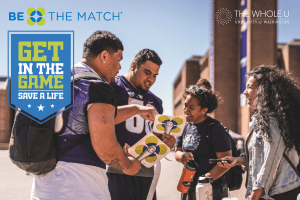
Imagine that. They didn’t hope and dream of an NIL deal, the transfer portal, an highlight on SportsCenter. They hoped to someday save a life. (Disclosure; My son stood in that line. To this day, he’s waiting, along with another few million heroes, for a call that he’s a match, understanding his great fortune to be on the healthy side of that ledger).
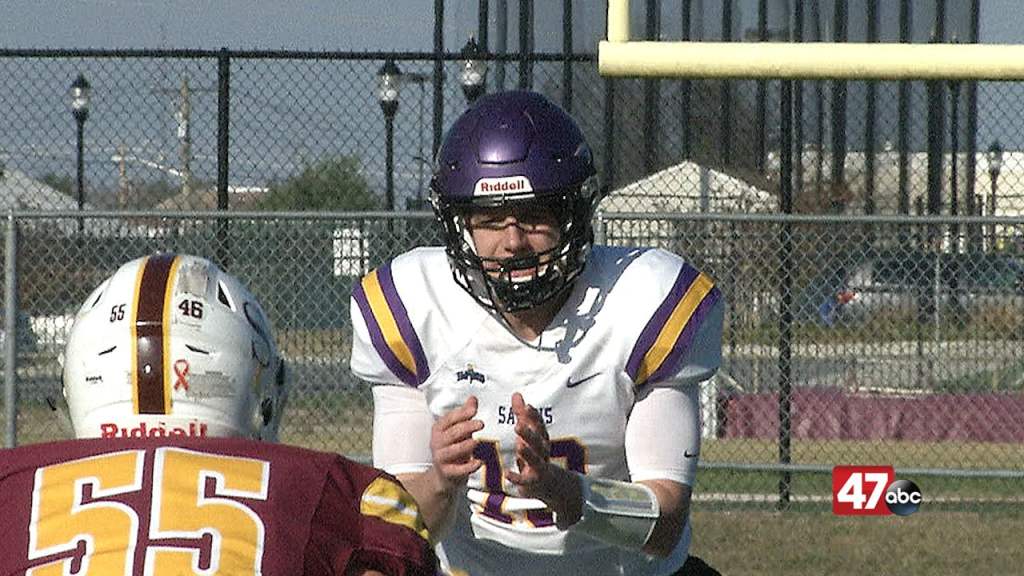
The goal of Be A Match is twenty-five million potential donors. That’s how many samples they need to cover enough DNA types to find a donor for every need. You know how to get to that number? You register one, then two, the twenty, then fifty. The Alfred University Saxon football team has added between fifty and a hundred blood types/DNA every four years since 2017. Gotta start somewhere, as long as you start. This is one team in one small corner of the United States, doing one thing, on one day.
According to the National Collegiate Athletic Association 87% of women and 83% of men volunteer on an annual basis. Fifty percent of student-athletes report they are required to take part in community service as part of their athletics participation. Most collegiate organizing bodies give away an award for community service, from NCAA Division I, through NJCAA (Jamestown Community College won the inaugural NJCAA Region III Community Service Award in 2010).

In January of 2022 Russell Kohler, a sophomore on the Alfred University football team from Seaford, NY, took an injection meant to stimulate the marrow in his blood and platelets, which the doctors would later make into stem cells. Later that year a 50-year-old male diagnosed with non-Hodgkin’s lymphoma was treated using Russell’s marrow. Russell said, “It happened so quickly, and I know a lot of guys that didn’t get phone calls and others that weren’t matches. I was just lucky enough to be a match. It really was not that big of a deal in my opinion. It was just doing the right thing.”
Try to tell me (or that 50-year-old man) that a single thing on (or off) a field of play is a more important story than that. It’s happening every day, all over the country.
Sport as entertainment, is an opt-in proposition. Nobody makes you buy a ticket for a game, watch ESPN, care about the latest grievance of owners versus players. You control the content of your world. They have to come to you. The only power we have over media is our attention. The only control we possess is what we choose to tune in to. If enough people chose to watch only the good stuff, the world of sports, the true value of it, would be a better place.
Note: To date, Be the Match has facilitated 80,000 marrow and cord blood transplants, treating diseases such as leukemia, anemia, immunodeficiency, sickle cell and various metabolic disorders. For more information about Be the Match, visit www.BeTheMatch.org

 Bill Burk's collective writing...and some other stuff.